

What is repricing?
Repricing is the automatic adjustment of your selling prices on marketplaces, based on rules you set. Instead of adjusting prices manually whenever the competition moves, a repricer does it in real time, within the limits you have defined yourself.
On marketplaces such as bol.com and Amazon, you often sell exactly the same product as dozens of other sellers. Price is then one of the heaviest-weighing factors in who wins the buy block, and therefore who gets the sale. Competitor prices change continuously, sometimes several times a day. Anyone trying to keep up manually loses that race.
Repricing is sometimes confused with 'always being the cheapest'. It is not. Good repricing is about staying competitive within rules that protect your margin. No race to the bottom. This guide explains how it works, which strategies exist and how to set it up flawlessly.
Repricing is a core part of professional multichannel selling, alongside automated listings and inventory synchronization.
Repricing in brief
Repricing adjusts your prices automatically based on competition and rules you set. The goal is not the lowest price, but the optimal price: competitive enough to sell, high enough to protect your margin.
Why manual pricing doesn't scale
With ten products on one marketplace, you can still watch prices manually. With hundreds of products across multiple marketplaces, that has become impossible.
There are a few reasons for that. The volume, to start with: every product on every channel has its own competitive landscape, and hundreds of SKUs times multiple channels are thousands of price points to monitor. Then the speed. Competitors adjust prices several times a day, and by the time you notice a change and implement it, the situation has changed again. Manual work also leads to errors: a wrongly typed amount, a forgotten channel, a price left too low or too high for too long. And that costs you both ways. A price set too high costs you the buy block and therefore sales. A price set too low costs you margin on sales you would have made at a higher price too.
Manual price management is also time you don't spend on growth. Automated repricing takes over that continuous, repetitive task, so you can focus on assortment, purchasing and expansion.
How automated repricing works
A repricer works in a continuous cycle. Knowing that cycle helps you set the rules better.
Step 1: monitor the market
The repricer tracks competitors' offers on the same product in real time: their price, their shipping costs and often their buy-block position.
Step 2: apply your rules
The repricer then compares that market data with the rules you have set: your floor price, your target margin and your strategy, such as targeting the buy block or matching the lowest price.
Step 3: adjust the price
Within your limits, the repricer calculates the optimal price and applies it, often within seconds or minutes of a change in the market.
Step 4: monitor and repeat
The cycle runs continuously. If the market changes again, the repricer responds again, always within your rules.
The key is in step 2: the rules. A repricer is only as good as the rules you give it. Good rules protect your margin and keep you competitive; bad rules chase you to the bottom. The following sections show how to set up those rules sensibly.
Repricing strategies
There is no single correct repricing strategy. The best choice depends on your product, your margin and your competition. These are the most commonly used approaches.
Targeting the buy block
The repricer adjusts your price to qualify for the buy block (on bol.com) or the Buy Box (on Amazon), without going unnecessarily low. The buy block weighs more than price alone, since delivery time and seller performance count too, so you often don't need to be the cheapest. This is the most used strategy for sellers competing on shared product pages.
Matching and slightly undercutting
For commodity products with many identical sellers, you maximize sales velocity by matching the lowest price or going just below it. That costs margin and is only wise if your purchase price or volume allows it.
Rule-based adjustment
You define specific conditions, for example: 'stay within 2% of the lowest competitor, but never below 15% margin'. The repricer operates strictly within that logic. This gives you the most control.
Profit-focused repricing
Instead of purely reacting to competition, this approach optimizes for your margin. The repricer seeks the highest price that still sells, rather than the lowest you can tolerate.
Many sellers use different strategies for different product groups: buy-block targeting for branded products, matching for commodities.
Beware the downward spiral
If two repricers keep undercutting each other without a lower limit, they race each other to the bottom and the margin evaporates for everyone. A well-set floor price is exactly what stops that spiral. Always set it before you activate a repricer.
The floor price: protecting your margin
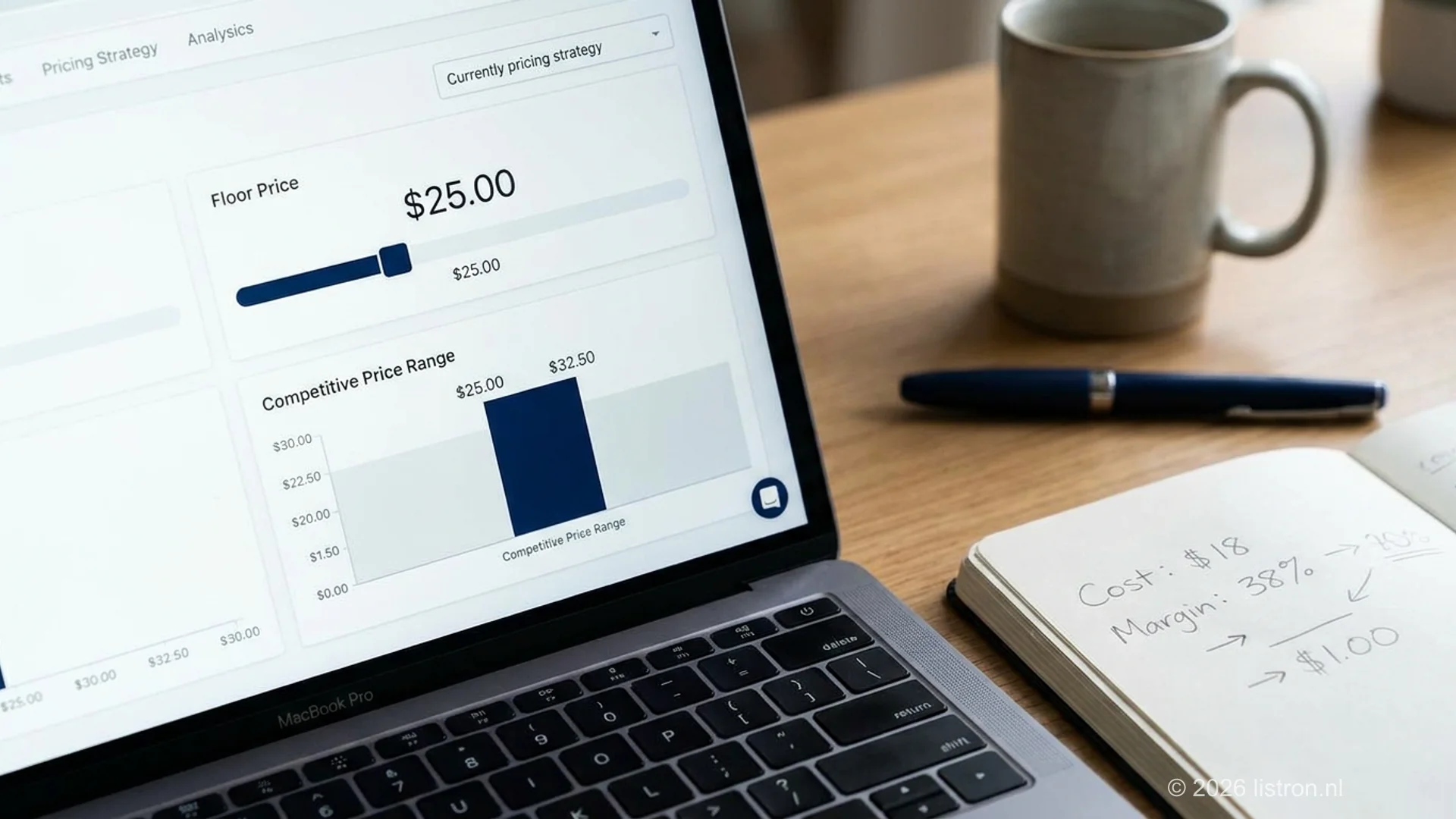
The floor price is the most important setting in any repricing strategy. It is the minimum price the repricer never goes below, no matter how aggressive the competition gets.
Why does that matter so much? Without a floor price, a repricer follows the market blindly downward. One competitor diving below their own cost price, whether through an error, a sale or a wrongly set repricer, drags you along if you have no lower limit set.
You don't determine a good floor price by feeling. You calculate upward from your purchase price. To the product's purchase price you add the marketplace commission, meaning the fixed amount plus the percentage. On top of that come the fulfillment costs, such as shipping or LVB and FBA fees. Also include a returns reserve, a percentage for expected returns. And finally your minimum target margin: what you want to keep at minimum. The sum of all that is your floor price.
The repricer may move freely within the range between your floor price and your desired price, but never below. Set the floor price per product, not once for your entire catalog, because margins vary greatly per product. Also see how different marketplaces bring different costs before you fix your floor prices.
Repricing per channel and per margin
A common misconception is to use the same price on every marketplace. That is almost never optimal.
Every marketplace has its own commissions and fulfillment costs. A product with a 20% gross margin in your webshop may yield only 12% net after Amazon's costs, and a different percentage again on bol.com. Your actual net margin therefore differs per channel, and with it your sensible selling price.
That is why you set repricing per channel. Each channel gets its own floor price, based on the actual costs there. Each channel also has its own competitive landscape, because the competitors and their prices differ per marketplace. And where needed, you choose a separate strategy per channel: buy-block targeting on one channel, a different approach on another.
Different prices on different marketplaces are entirely legitimate and usually wise. A marketplace integrator with per-channel repricing carries this out automatically, so each channel is profitable on its own merits instead of one channel subsidizing the loss of another.
Automate your prices across all marketplaces
Listron adjusts your prices in real time with per-channel repricing rules: win the buy block, protect your margin with a floor price, all from one platform.
Request a demoChoosing a repricing tool
Repricing is a core function of a good marketplace integrator. When choosing, look at four points.
Rules per product and per channel
Can the tool set a separate floor price, desired price and strategy per product and per channel? One-size-fits-all repricing forces wrong compromises.
Speed of response
How fast does the repricer respond to a change in the market? Minutes is good, hours is too slow on competitive products.
Transparency
Can you see why the repricer chose a particular price? Insight into the logic helps you refine rules and spot errors.
Integration with the rest of your operation
Repricing is not separate from listings and inventory. A platform that combines repricing, inventory sync and order management gives you a coherent operation instead of separate tools.
At Listron, repricing is included in the platform, with no separate module or per-country surcharge. Compare your options more broadly in our overview of the best marketplace integrators.
Common repricing mistakes
Using repricing wrongly can damage your margin faster than manual work. Avoid these mistakes.
Not setting a floor price
The most dangerous mistake. Without a floor price, your repricer follows the market below your cost price. Always set it first.
One price for all channels
Costs differ per marketplace, so your prices and your floor prices should too. Reprice per channel.
Steering only on the lowest price
The buy block weighs more than price alone. By blindly chasing the lowest price, you sacrifice margin you could have kept with strong seller performance.
Setting repricing and forgetting it
Your rules are not a one-time setting. Costs change, competitors appear, margins shift. Review your repricing rules periodically.
Calculating the floor price too tight
If you forget to include returns or another cost item, your floor price is set too low and you sell at a loss while the repricer operates neatly 'within the rules'.
Getting started with repricing
Automated repricing turns price management from a continuous manual burden into a controlled, scalable process. The route there:
- Calculate your floor price per product: purchase, commission, fulfillment, returns reserve and your minimum margin.
- Choose a strategy per product group, such as buy-block targeting for branded products and matching for commodities.
- Set repricing per channel, with a separate floor price based on the actual costs there.
- Start in a controlled way. Activate repricing first on part of your catalog and review the results.
- Measure and refine. Track your buy-block share, your realized margin and your sales velocity, and adjust your rules.
Well-set repricing keeps you competitive without your margin leaking away, and it scales effortlessly as your catalog and channels grow.
Ready to automate your prices? Schedule a demo with Listron and discover how repricing, inventory sync and listings come together in one platform.